
Before you zip your bag and head for the airport, sort your medications out properly. Border officers in Canada can and do inspect medications closely, and the difference between a smooth crossing and a prolonged secondary inspection usually comes down to paperwork you either have or don’t.
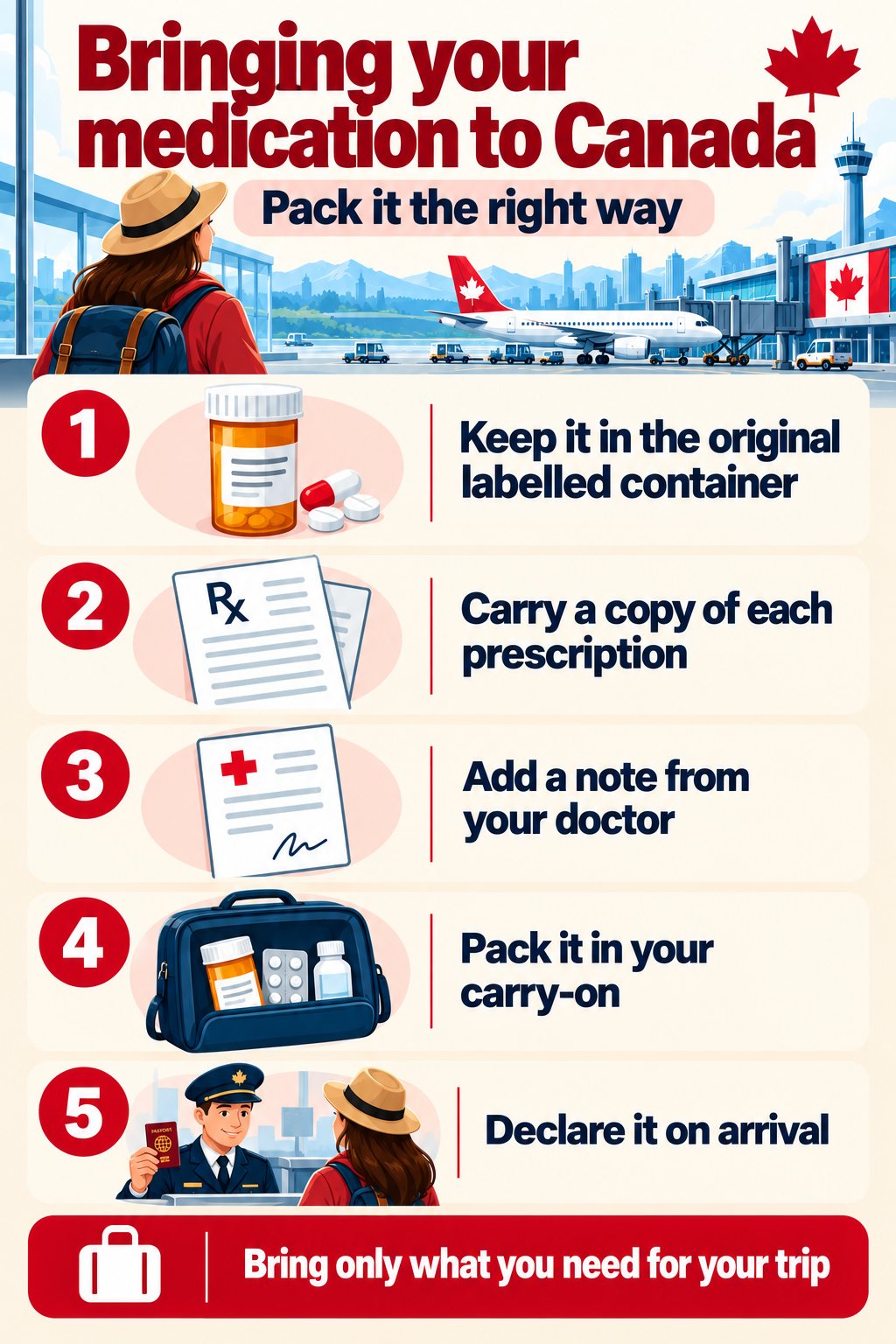
The short answer: bring your meds in their original labelled containers, carry a copy of each prescription and a doctor’s note explaining why you take them, keep everything in your carry-on, and declare what you have, the same way you declare any food you are bringing in. That covers most situations. The sections below fill in the details, including the cases where the rules get sharper.
If your trip also involves sorting out your eTA before you fly, the Canada eTA application status check guide covers how to confirm your authorisation is linked and ready. Travellers who carry medications that could attract extra scrutiny at the border should also make sure their travel documents are fully in order well before departure: if you have recently renewed your passport, check whether your existing eTA is still valid by reading My Canada eTA Was Approved, But I Applied for a New Passport. Can I Still Use My eTA?.
Essential Documents to Pack with Your Meds
Three documents do most of the work here:
A copy of each prescription. Include both the generic and trade names of the medication: generic and trade names matter because the same drug can appear under different names on different packaging, and an officer who doesn’t recognise one name may recognise the other. If a container goes missing or gets flagged, this is what establishes that the drug was legitimately prescribed to you.
A doctor’s note. This explains why you take the medication. It’s a short letter, not a medical file. Your GP or specialist can produce one for you, and it matters most for anything that looks unusual in quantity or type. If you take multiple medications, a single note that covers all of them is more useful than separate letters that an officer has to cross-reference.
A complete medication list. Your pharmacist can print this for you: pharmacists are specifically equipped to provide a full list of all medications, including dosages and frequencies, in a format that’s easy for a third party to read. It should name every medication you’re carrying. Border officers may ask about medications even when everything looks routine.
Having all three ready is what resolves questions quickly at the border. Without them, you’re asking an officer to take your word for it. Medications may be closely inspected upon entry into Canada, and the inspection is faster and less disruptive when your paperwork answers the obvious questions before they’re asked.
Packaging and Labeling Medications for Border Crossing
Keep every medication in its original, pharmacy-labelled container. Don’t consolidate a month’s supply of three different pills into one unlabelled bottle to save space. It creates an immediate problem: the officer can’t verify what the medication is, who it was prescribed to, or what the dose is.

If you use a weekly pill organiser at home, bring it, but also bring the original bottles. You don’t need to carry the full supply in the original bottles, but having them available removes any ambiguity about what’s in the organiser.
All medications and medical supplies should travel in your carry-on luggage, not in checked bags. Keeping them in your carry-on means they stay with you at all times and you can provide information about them if needed: both at the border and during the journey itself. If your checked bag is delayed, lost, or temporarily inaccessible, your medications are still with you. This matters most for time-sensitive medications where missing a dose has clinical consequences, but it’s the right approach for any prescription medication regardless of how routine it seems.
If you travel with injectable medications (insulin, biologics, or anything administered by syringe) the same documentation rules apply, but the inspection is often more thorough. A doctor’s note that explicitly mentions the injectable form of the medication, not just the drug name, removes ambiguity quickly. Sharps containers are worth bringing as well: disposing of used needles safely during travel is your responsibility, and not every destination provides suitable disposal options. If you rely on a medical device (an insulin pump, for example) carry the manufacturer’s documentation alongside your prescription paperwork. Officers may not be familiar with every device, and a brief written explanation of what it does and why you need it is faster than an improvised explanation at a busy border crossing.
Quantity Limits for Prescription Medications
Available guidance doesn’t specify a fixed number of days’ supply that’s automatically permitted, and any figure you may have seen online for other countries doesn’t necessarily apply at the Canadian border.
Carrying enough for your trip plus a small buffer is sensible and normal. If you’re bringing a larger quantity for a legitimate reason (a long stay, a medication that’s difficult to source in Canada), your doctor’s note should say so explicitly.
The practical rule: match your supply to your itinerary, document the reason if the quantity is large, and don’t assume that what’s permitted in one country applies here.
One scenario worth thinking through: what happens if your medication is delayed in transit or your checked bag is temporarily held? If your medication is in your carry-on as recommended, this doesn’t arise. But if for any reason you are separated from your supply, having a copy of your prescription and your doctor’s note in a separate location (a travel wallet, a phone photo, or an email to yourself) means you can at least demonstrate what you need and why. A pharmacist or clinic in Canada may be able to assist in an emergency, but the process is easier when you can show documentation rather than describe the medication from memory.
Another scenario: travelling with a companion who manages your medications for you, or travelling with medications that belong to a dependent. The documentation should still name the person the medication was prescribed to. An officer who sees a prescription in one name and a passport in another will ask questions, and a brief explanatory note from the prescribing doctor resolves this quickly.
Special Considerations for Controlled Substances
Some medications that are routine in one country may be treated very differently at the Canadian border. Documentation matters more in these cases, not less. A doctor’s note explaining the diagnosis and the treatment plan, combined with the original pharmacy-labelled containers and a copy of the prescription, is the minimum. Before you travel, verify local requirements and ensure you have appropriate documentation for any prescription medications you are carrying. Whether any additional permit or exemption is required depends on the specific substance and is worth confirming with the relevant health or border services guidance before you fly.
One firm line: cannabis and all cannabis-derived products, including CBD oils, are illegal to bring across the Canadian border regardless of the laws in your home country or in Canada itself. This applies unless authorized by Health Canada and in line with the laws of the country you are travelling to. Trafficking drugs across the border is a criminal offence, not a customs infraction. There’s no grey area here. The other visitor limits, for alcohol, tobacco, gifts and cash, are in the duty-free allowance guide.
If You Need to Refill a Prescription While in Canada
This means if you run out of medication mid-trip, getting a refill is not as simple as walking into a pharmacy.
The straightforward fix is to bring enough. Calculate your trip length, add a few days’ buffer for delays, and pack accordingly. If your condition is complex or your medication is difficult to source, carry documentation that explains your needs.
A note on buying medications while abroad: if you’re travelling to Canada from another country and stop elsewhere along the way, don’t purchase medications outside Canada unless a healthcare professional advises it. Counterfeit medications are a real risk in some markets; they may contain harmful ingredients not listed on the label and may not be effective. Keep the original packaging of any vaccines or medications you receive during travel, or photograph it, and review what you were given with your own doctor when you return home.
If you have questions about eTA rules, validity periods, or how your passport affects your travel authorisation, you can find answers to common scenarios in our eTA FAQ. Travellers who are ready to travel and want to confirm their authorisation before departure can also check the status of your application to make sure everything is in order.